
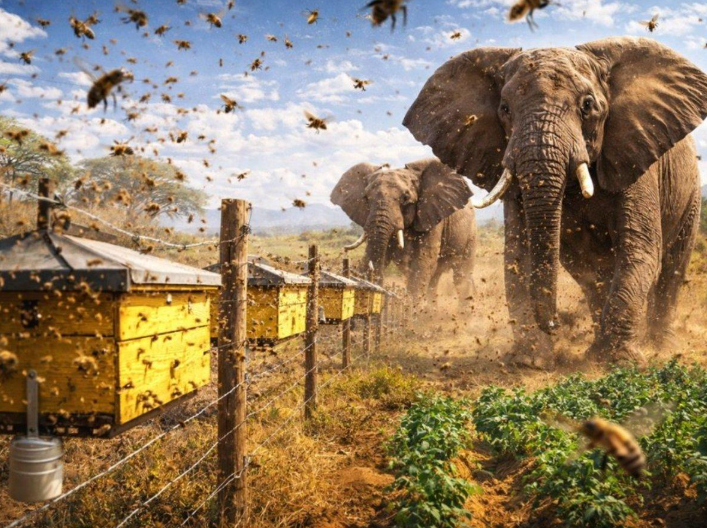
Despite being the largest land animals on Earth, elephants have a surprising fear of one of nature’s smallest creatures—bees. While their thick skin protects much of their bodies, sensitive areas such as the eyes, ears, and trunk are vulnerable to painful stings. A swarm of angry bees can quickly overwhelm an elephant, making it safer to retreat than risk repeated attacks.

Scientists have discovered that elephants can recognize the sound of buzzing bees and respond by moving away, even before seeing a hive. They also communicate the danger to other members of the herd through low-frequency rumbles and body language. This learned behavior helps protect both adults and young calves, whose thinner skin makes them even more susceptible to bee stings.

The relationship between elephants and bees has inspired an innovative conservation solution known as the beehive fence. In many parts of Africa, farmers place beehives around their fields to discourage elephants from entering and damaging crops. When elephants disturb the fence, the hives shake, causing bees to emerge.

Rather than risk a painful encounter, the elephants usually choose another route. This simple, non-lethal approach reduces human-elephant conflict while allowing both people and wildlife to coexist peacefully.

Bees also provide valuable benefits beyond protecting crops. They pollinate plants, support healthy ecosystems, and produce honey that can generate extra income for local communities. This remarkable partnership shows that even the smallest creatures can play a powerful role in conservation. By understanding and working with nature, we can create solutions that protect elephants, support livelihoods, and preserve biodiversity for generations to come.