
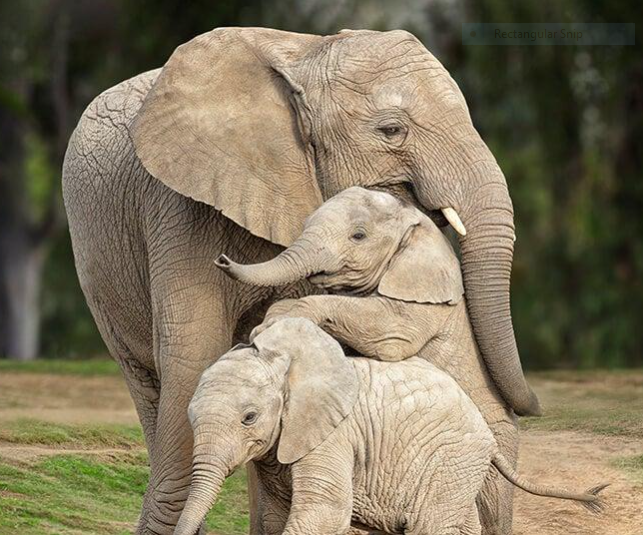
Elephants are deeply social animals whose lives are shaped by family bonds, communication, memory, and cooperation. Anyone who has watched elephants gently touch one another with their trunks, protect a calf, or gather around an injured companion may wonder whether these remarkable animals experience emotions.

Scientific observations strongly suggest that they do.
Although humans cannot know exactly what an elephant feels, decades of research and field observation have revealed behaviors associated with affection, distress, reassurance, excitement, fear, and grief. These emotions appear to play an essential role in helping elephants maintain their complex relationships and survive together in the wild.
Strong Family Bonds

Elephant society is built around close and lasting relationships. Female elephants usually live in family groups led by an experienced matriarch. Mothers, daughters, sisters, aunts, and calves may remain connected for many years, caring for one another and sharing responsibilities.
Calves receive attention not only from their mothers but also from other females in the herd. These helpers, sometimes called allomothers, protect young elephants, guide them through unfamiliar situations, and comfort them when they become frightened.
Physical contact is an important part of these relationships. Elephants frequently touch one another with their trunks, lean against companions, or stand close together. These gentle interactions can reinforce trust and provide reassurance.
Comforting Distressed Companions
Elephants appear highly responsive to the emotional states of others. When an individual becomes alarmed or distressed, nearby elephants may approach, vocalize softly, and touch the affected animal around the mouth, face, or body.
These comforting behaviors resemble forms of reassurance seen in other highly s
Their reactions also suggest that they are able to recognize when another elephant is experiencing difficulty. This emotional awareness is especially valuable in environments where families must respond together to threats, injuries, drought, and unfamiliar surroundings.
Joy, Play, and Excitement

Elephants also display behaviors that appear connected to pleasure and excitement.
Calves often chase one another, splash in water, slide down muddy banks, climb over companions, and play with sticks or other objects. Young elephants may flap their ears, trumpet, spin around, or run with exaggerated movements during energetic play.
Adults can also become visibly excited during reunions. Elephants that have been separated may greet one another with loud calls, rapid ear movements, trunk touches, and close body contact. These reunions can involve several members of the family and may continue for several minutes.
Play is not simply entertainment. It helps young elephants develop coordination, confidence, communication skills, and an understanding of social boundaries.
Fear and Stress

Like other animals, elephants experience fear when they detect danger. They may become alert, raise their heads, spread their ears, freeze, retreat, or gather protectively around calves.
Elephants can remember threatening experiences for long periods. Encounters with people, predators, vehicles, or unfamiliar noises may influence how they respond in the future.
Long-term stress can have serious effects on elephant well-being. Habitat loss, family separation, conflict with humans, captivity, and repeated disturbance may disrupt normal behavior and social development. Young elephants are particularly dependent on stable family relationships while learning how to respond to the world around them.
Grief and Responses to Death
![[애니멀리포트] 코끼리는 서로 ‘이름’ 부른다 - 조선비즈](https://images.openai.com/static-rsc-4/XMnUAu3rZDgyMq-Yf1QLcvr7_74dUNuSqPZs5CiPt14HB_UtOL00kc0YDLXNxWsxo5QOtJpo7mAbOtOVdB2inrS_c363-FBG669S15VpnPt3zFyc8K75rivCf7_CAlZe5Mkn_4BbxZ7ctklD3S79x-YqZQkd8up45qfm1t32B-9BMoC31bUOXPlnH8rlKdDA?purpose=fullsize)
Some of the most powerful observations of elephant behavior involve their reactions to dead companions.
Elephants have been seen approaching elephant remains, examining bones with their trunks, standing quietly nearby, and returning to the location later. Family members may remain close to a dying or deceased individual and show changes in behavior after the loss.
Scientists are careful when interpreting these actions because animal emotions cannot be measured in exactly the same way as human feelings. However, the repeated attention elephants give to the bodies and bones of their own species suggests that death has significant social meaning for them.
Their responses are especially moving because elephants form long-lasting relationships and possess strong memories. Losing a mother, calf, sibling, or close companion can alter the structure and daily life of an entire family.
Empathy and Helping Behavior

Elephants have also been observed helping companions in difficulty. They may support an injured individual, assist a calf struggling to climb a bank, or work together to protect a vulnerable member of the herd.
When calves become trapped or separated, several adults may respond. One elephant may guide the calf while others stand nearby, guard the area, or help clear a path.
These actions reflect the importance of cooperation in elephant society. Survival depends not only on individual strength but also on the ability to understand, support, and respond to others.
Communication and Emotional Expression
Elephants communicate through sound, touch, scent, posture, and movement. Some of their calls are low-frequency rumbles that can travel over long distances.
Different vocalizations may be used during greetings, warnings, contact between separated family members, mating, conflict, and reassurance. Ear position, head movement, trunk posture, and body tension can also provide clues about an elephant’s emotional state.
Because much of elephant communication is subtle, people may overlook the complexity of these exchanges. A quiet rumble or gentle touch can carry important information within the herd.
Why Elephant Emotions Matter
Recognizing that elephants have rich emotional lives changes how we understand our responsibility toward them.
An elephant is not simply an individual animal moving through a landscape. Each one belongs to a network of relationships built over many years. When a family is disrupted, the consequences may extend far beyond the loss of a single member.
Protecting elephants therefore means more than preserving population numbers. It means protecting family groups, migration routes, sources of food and water, and the social knowledge passed from older elephants to younger generations.
Elephants remind us that emotion is not limited to humanity. Through affection, cooperation, play, fear, and mourning, they reveal a sensitive and deeply connected way of life.
By respecting their emotional bonds and protecting the habitats where those bonds can flourish, we help ensure that elephant families can continue to live, learn, and care for one another for generations to come.