
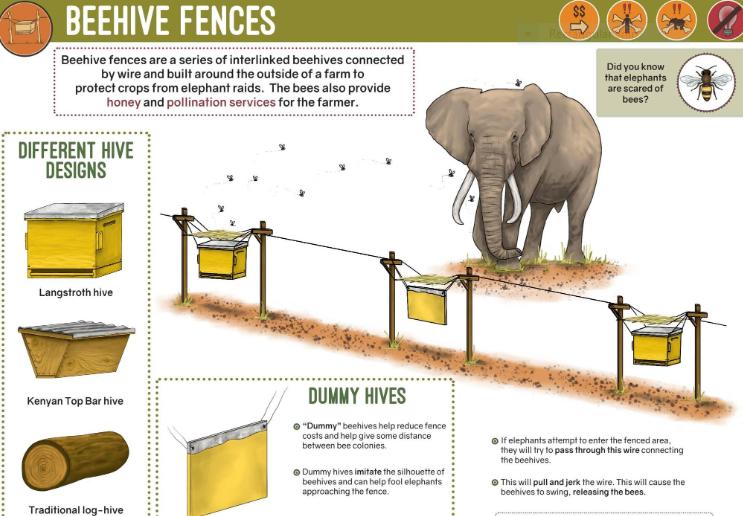
Beehive fences are an innovative and nature-friendly solution that helps reduce conflict between farmers and elephants. These fences consist of beehives suspended on wires around the edges of crop fields. When an elephant tries to enter a farm, it bumps into the wire, causing the hives to swing.

The disturbed bees fly out to defend their nests, and because elephants are naturally wary of bee stings—especially around their sensitive trunks and eyes—they usually move away without damaging the crops.

This simple, non-lethal method protects both wildlife and local communities. Research in Kenya found that well-designed beehive fences successfully deterred about 80% of elephants that approached protected farms.

In addition to keeping elephants away, beehive fences provide important benefits for farmers. The bees pollinate nearby crops, helping improve harvests, while the honey produced by the hives can be sold for extra income. This creates a sustainable conservation model in which both people and wildlife benefit.

Beehive fences are also more environmentally friendly than electric fences because they do not harm animals and require fewer resources to maintain. As more communities adopt this approach, they are proving that peaceful coexistence between humans and elephants is possible.

By protecting farmland while preserving elephant populations, beehive fences offer a practical example of how nature itself can help solve conservation challenges.